Pages

Saturday, December 23, 2006

The Red Balloon, directed by Albert Lamorisse

The Red Balloon is my favorite film, I first saw it when I was 8. It's a beautiful film, I hope you enjoy it.

The Red Balloon Part 1

The Red Balloon Part 2

The Red Balloon Part 3

The Red Balloon Part 4

Source: bloodydoisneau

The Red Balloon is not Just a Child’s Film

The film The Red Balloon, directed by Albert Lamorisse, is, on the surface, a short, pointless movie about a young boy and a red balloon he finds. It is, on a higher level, a metaphor for friendship and a barometer for the viewer’s imagination, and inspires thought. It is a story about a boy who finds a red balloon caught on the top of a street pole. He really likes his balloon, and carries it on his way to school. However, balloons are not allowed on the bus, so the boy must either abandon it or miss the bus. He opts to miss the bus, because who would want to abandon a friend to get to school on time? This causes him to be late to school, and since he obviously cannot bring the balloon into school, he gives it to the janitor to keep until he is out. The janitor gives it back at the end of the day, and the boy walks back home, only to find that his mom does not want the balloon in the house, and throws it out the window. Most balloons would fly up and be lost forever, but this was the boy’s friend. It stays hovering outside his apartment window until morning. Those are the events of just one day, and this film spans several.

The acting in The Red Balloon is superb. The film does not have any dialogue, only sound effects, and an occasional unintelligible shout, so the actors’ abilities are really put to the test. For a young child actor such as the boy in this film, it would have to be a great challenge, and he was up to it. He portrays the perfect innocent little boy, making it seem like the genuine article. He emits an innocence and naiveté that are typical of a boy his age, and the adults in the film also seem genuine.

Sound is very important in a movie such as The Red Balloon, where there is no dialogue. Lamorisse does a fantastic job of choosing appropriate music and sound. For example, when the boy first climbs up the light pole to get the balloon, a playful little tune that seems a little mischievous plays in the background, and for sound effects, a good example is when the boy is running from a group of schoolboys trying to steal his balloon; in this particular scene the footsteps are loud and sound ominous as they close in on the poor little boy and his balloon.

The story is great, because it shows a little measure of ourselves in it. If you’re young or young at heart, you can instantly understand how the boy feels about his balloon and why he makes the choice to let the balloon use the umbrella on his way home from school, rather than keep himself dry. If you’re an adult or a realist, it makes you feel that maybe you should let a little more imagination into your life.

Cinematography is one of the most important features of a film, in my opinion. It is synonymous with the readability of an article or book, in that it dictates both the flow of the piece and the overall impression. The cinematography in The Red Balloon manages to emit suspense and a sense of urgency during the action scenes. One particularly good example is when the boy stops near a train yard to look at a train far below. He has the balloon with him, and he is by a metal fence with particularly sharp ornamental points on top. Just as the balloon nears the points, a wisp of fog or smoke from below obscures it so the viewer is left wondering what happened to the balloon -- whether it popped or not.

Another example to illustrate the great cinematography is a shot where the camera is aimed straight down a narrow alley. This shot occurred during a chase where some cruel schoolboys are chasing the boy with the red balloon. The boy with the balloon pauses for a while and hears footsteps, and since there is no way to see which direction they are coming from, the suspense is transferred from the boy to the audience. When they suddenly come into view, the viewer feels suspense just as the boy does.

Overall, I would recommend The Red Balloon for all ages, not just children or not just adults, because it is a two-for-one movie deal, philosophy and entertainment, combined in a fantastic package.

Source: LargeSock's Writing

Thursday, December 21, 2006

Happy Holiday's Music Video by Natural Childhood

Happy Holiday's Music Video by Natural Childhood

Music by Telepopmusik - Just Breathe. Images of children from around the world

Happy Holidays from Natural Childhood & Dyslexia Network

Monday, December 18, 2006

Documentary About Me - Created By Kyle Evan's

Source: You Tube

School lessons to focus on play

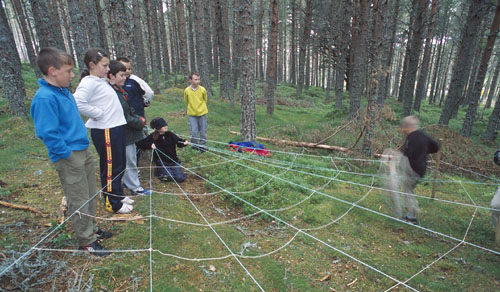
School children learning about spiders through play, Scotland

Children will spend more time being taught through play rather than formal classes when they start primary school under a shake-up of the curriculum.

An increasing number of children entering primary one from next August are to learn through techniques traditionally used in nursery school.

Schools will still use traditional methods when necessary to teach pupils to read, write and count.

But the Scottish Executive also wants teachers to use play-based techniques.

It means drama, music, art, sand and water will replace worksheets or teaching from the blackboard.

The changes have already been introduced in some schools, including primaries in East Renfrewshire and Shetland, but the executive wants to see all local authorities backing the approach.

The aim of the changes is to bring Scotland closer to the approach taken in Scandinavia, where children start school at the age of seven but still go on to achieve high academic standards.

Some experts feel the current system creates a gulf in a child's experience between nursery and primary as learning through play is immediately replaced by more formal techniques.

'Gradual transition'

Education Minister Hugh Henry said every local authority across Scotland must have reviewed, or be reviewing, their policies on P1 education by next summer.

He added: "One of the things I am particularly concerned about is the tendency in Scotland to start the formal education process at too young an age.

"I want to see more of a gradual transition from the nursery years into primary education.

"We need to move away from the concept of teaching where pupils are given worksheets and are instructed, to a process where children can develop on their own through purposeful play."

However, Judith Gillespie, policy development officer with the Scottish Parent Teacher Council, warned the executive to take a cautious approach.

Hard work

She said: "I think the difficulty with these kinds of ideas is that when they are introduced there is a tendency to go overboard in one direction.

"Whilst play is an important part of learning, youngsters have to do the hard work and at the end of the day there is a reward for hard work.

"Learning can't always be fun - there is hard work required and it is a mistake to think that the big incentive is to make everything fun."

SNP education spokeswoman Fiona Hyslop MSP said her party had been calling for the changes for some time.
She added: "However, the Lib-Lab government must ensure that there is more time for teachers to implement these proposals and work with children in structured play."

Source: BBC

make school make sense in Scotland


The National Autistic Society
NAS Scotland launched its make school make sense education campaign on 31 October at the Scottish Parliament.

Send a make school make sense postcard to your MSP(s) asking him or her to raise the make school make sense campaign demands in Parliament and to write to the Education Minister - order yours today!

we've been filmed, photographed and interviewed for the National Autistic Society "make school make sense" campaign which is launched today in Holyrood (Scottish Parliament).www.nas.org.uk/nas/jsp/polopoly.jsp?d=1083&a=10644this is the current state of affairs in the UK and this is what we want to changeOver a third of children with autism have been bullied at schoolOver a third of families had to wait longer than a year before their child received any support at school1 in 110 children has autism but there is currently no requirement for teachers to undertake any training in autism and just one in three parents are satisfied with the level of understanding of autism at their child's schoolour tv appearance on the BBC reporting Scotland programme is available on this site for just 24 hours there is link to the video on the right hand side of this page. not the long version wwhich included Laurie talking - shame but we got it on

video news.bbc.co.uk/1/hi/scotland/6100622.stm

Autism is complex. Our demands are simple.

make school make sense

Significant failures in our education system are causing misery for many of the 46,064 people affected by autism in Scotland:

  • Over a third of children with autism have been bullied at school
  • Over a third of families had to wait longer than a year before their child received any support at school
  • 1 in 110 children has autism but there is currently no requirement for teachers to undertake any training in autism and just one in three parents are satisfied with the level of understanding of autism at their child's school

Take action in Scotland -->
Take action here for the make school make sense campaign if you are resident in Scotland.

Our demands -->
The right school for every child. The right training for every teacher. The right approach in every school.

Campaign news in Scotland -->
Follow what's been happening in Scotland and find out about the activities at NAS Branch level

The evidence -->
Significant failures in our education system are causing misery for many of the 90,000 children with autism and their families in the UK. Read some of the statistics.

make school make sense heroes in Scotland -->
Do you know of someone who has made a positive difference to your experiences at school, or the experience of your child with autism? This is your opportunity to recognise them as a make school make sense hero!


Actress Dawn Steele says:

"The National Autistic Society Scotland's make school make sense campaign seeks to improve educational provision for children with autism. Let's help every child with autism in Scotland fulfil their potential. Let's make school make sense. Please join me and act now!"


Source: The National Autistic Society Scotland


Friday, December 08, 2006

Scotland's speed king is still top of the tree


DO you want the two-minute interview or the five-minute interview? It isn't like that with Sir Jackie Stewart. "Take your time, I've got all the time in the world," he told me.

But he measures it, to fractions of a second. I'm eyeing what's adorning his wrist. One of those chronometers to die for. Something that comes with the job.

Jackie was in town on Monday night. He'd flown up from his Bucks home for the day, expressly to switch on the lights on the St Columba's Hospice Tree of Remembrance in Charlotte Square Gardens. Together with Sir Tom Farmer.

My, but the man does put himself about. He's on the Scottish Enterprise Board (advisors to parliament, with direct access to Jack McConnell, but didn't have time to drop in on Jack in Bute House, just strides away from the gardens).

Of all the Scottish accents, Jackie's - soft, articulate, almost mesmeric - is the one you'd have represent us round the planet.

Go on, sir. Your native country. Tell us how you see it through the constant voyager's eyes.

"Our greatest export has always been people. Everywhere I go there's always a Scot at the top end of the company.

"New technologies that are coming on stream are giving Scots great opportunities. We've always been exceptionally creative and in this respect our universities are playing a major role.

"I'm talking to Aberdeen and Edinburgh universities about dyslexics and how they find other ways of doing business. Ten per cent of Scots are dyslexic and they don't find jobs easily.

"I'm dyslexic myself and it's because I've always done things differently from more of my fellow humans that I've survived, and survived pretty well.

"Most of the clever folk in my class at school haven't done particularly well - not because they've not been ambitious but they've not been obliged to think the same way as dyslexics.

"What I aware of - something that never escapes my mind - is that more than 50 per cent of the workforce in Scotland works for the government and clearly that's too much."

Too much for Jackie, this ambassadorial role that has him perpetually mobile? No way. He positively thrives on it. He surely has found a different way of coping.

"I'm deeply associated with the Royal Bank. I've been their global ambassador for three years through their ties with the Williams team in Formula One.

"Let me tell you, I've seen their new headquarters here. The most impressive headquarters I've seen anywhere in the world and that includes IBM, American Express and General Motors. Because of my connections in so many countries, I create new business opportunities for the bank."

He's telling me all this and somehow managing not to sound bombastic, big in the head. It must be the dyslexia that does it.

"I've been on the board at Moet & Chandon since '69. And I'm still with Rolex, since '68. You know what they say, everything in life is about timing."

Precisely. And it was time, in this ten-minute interview, to inquire about that eye-catching time machine on his left wrist. He fobbed me with "it's a gold GMT Master".

Christmas Day will find him at home in Buckinghamshire with Helen. They married in 1962. They fly to their other place in Switzerland on the 28th to bring in the new year with the family. "We have eight grandchildren. No great strain on Helen and me. You get to hand them back."

A watchnight service, perhaps, on Christmas Eve? "No. I'm Church of Scotland, from the day I was born 67 years ago in Milton, Dunbartonshire. While I'm not a great churchgoer, I deeply believe in God.

From time to time I'll go into a church, synagogue, mosque or whatever and pray."

Long may the three-times world champion driver keep travelling on a wing and a prayer. The watch, by the way, Hamilton & Inches were today able to confirm, retails at £11,670.

My advice to Sir Jackie Stewart, slip it off before you go into a football match or stroll Sauchiehall and Princes Streets.

Source: The Scotsman

Tuesday, December 05, 2006

Learning Difficulties Awareness- Video

In A world without learning difficulties (Famous people with learning difficulties) Its amazing what you can achieve !

Dyslexic prisoners BBC Interview with Jackie Hewitt-Main - Video


Jackie Hewitt-Main appeared on BBC Look East talking about Dyslexic prisoners.

My week: With Dyslexic Camila Batmanghelidjh

Camila Batmanghelidjh and Children from
Kids Company

The founder of Kids Company is moved by the father of murder victim Tom ap Rhys Pryce, attends a party at Richard and Ruthie Rogers' house and intrigues the lingerie staff at John Lewis.

In the early hours of Monday I am woken by a call saying that one of our young Kids Company people has completely lost it. He has smashed up his flat and the police can't calm him down. This is a boy who was abused by his mother and later by a foster carer. These kids can't calm down when they have a nightmare or a flashback because they have no self-soothing repertoire. I spend an hour and a half trying to stabilise him, eventually go back to bed and wake up in the morning with fat bags under my eyes.

It only takes me a few minutes to get dressed. I love wearing yards of bright textiles. My latest thing is to make fingerless gloves out of tights. I went into John Lewis and bought a pair of tights and cut them up in front of the sales person. She couldn't believe it. I've dressed like this since I was a child. I'm a mixture: I'm wise but I completely undo myself with my childishness.

I start the week by giving a talk to the Howard League for Penal Reform. I explain how some inner-city children are exposed to the same level of trauma as a war veteran.

In the afternoon I go to the BBC where I'm making a radio series for the World Service on childhood. In the middle of all this - and this typifies my life - I'm making calls trying to get psychiatric intervention for a young girl who has been raped by her father. I must be the most frustrating person to work with in the BBC. I get home late. When it comes to relationships my vocation comes first. That's why I didn't have children. My heart is actually with these children. I don't regret it, I don't feel depleted, I'm just made that way. I'm just here to shift the ground a bit.

On Tuesday, at Kids Company, staff are really worried because we're going to get around 800 children at Christmas and we just don't know if we have the resources. December is a horrible month for our children because the media is full of portrayals of happy family Christmases. It's very important that we're open on Christmas Day. We try and give each child a personalised bag of presents and do lunch.

So we've all been panicking about money, but then wonderful things happen. For example, we got a letter saying that a man who was dying had asked his family not to send flowers to his funeral, but to give donations to Kids Company. The money has been arriving from his relatives... it makes me cry.

Libby Purves did the same thing when her son died. She's breathtaking - and currently mentoring one of our kids. Cherie Blair has been amazing, as has the Prince of Wales.

Later, the Today programme invite me on tomorrow's show. There's a new study by Glamorgan University, arguing that 'street culture' is a key motivating factor in muggings rather than money. I do get called a lot by the media because there aren't very many people who can stick up for these children in what I call 'a sound-bite moment'. You have to do it in a split second.
In the evening I go to the South London Press heroes awards. I'm one of the judges, alongside Doreen Lawrence. Every year I fight back the tears, it's so moving.


On the way to the Today studio on Wednesday morning, I hear the interview with the father of Tom aps Rhys Pryce. The man's dignity takes my breath away. To have lost your son and to be curious about why these children [Tom's killers, Donnel Carty and Delano Brown] ended up being different from his child, is emotional generosity beyond belief. So already I feel hopeful that this debate won't just be about 'monstrous children'.

When it comes to my interview, I try to convey the chemistry of terror that many kids are caught in. And then when they're strong enough to make a shift from a victim to a perpetrator, they feel high. And it is that craving for excitement that motivates a lot of street crime.
I'm struck by how much room John Humphrys gives me to explain. After all, he has a child himself. Yes, he challenges me when I say kids like Delano and Carty are 'thermostatically impaired'. He's right to wonder because it's not a label that's in current vocabulary, but it perfectly describes these kids.


On Thursday I visit my endocrinologist to give blood. I've always been big because I have an endocrine disorder, but I've always felt at ease with my body. At the surgery, everyone has a good laugh about my outfits. I tell them I met my niece and nephew at a very posh hotel recently and they cut the antique tassels off the bottom of the sofa because they thought I would like them to wear.

Later I go on to a cocktail party for Kids Company's 10th anniversary at Richard and Ruthie Rogers' house. There are bankers and philanthropists and well-known actors. I look round the room and marvel. When I first arrived in England as a refugee I knew nobody.

I've brought some of the children with me. One little boy who came to us last Christmas used to box everybody; now a year later I'm able to take him to a cocktail party. He's still a bit nervous; I watch him dangling pieces of ham. But he takes it all in his stride.

On Friday I'm still trying to get psychiatric intervention for the girl. In the evening I give a speech at a college. It's very important for young people to understand what's happening, because they are often victims of violence.

On Saturday I work from home, dictating letters - I'm dyslexic so I can't use a computer or anything. The kids programme the latest music into my mobile. There's a very rude song that makes me laugh. Humour is very important because we are dealing with such raw tragedies.
The most touching thing is the people who stop me in the street - cab drivers, bus drivers - to talk about the sheer number of people they know who've had rotten childhoods. I think they see me as someone who is putting secrets on the table.


The Batmanghelidjh CV

The life Aged 42, half Iranian and half Belgian. Born in Tehran into a wealthy family, she came to England aged 12. She gained a first class degree in fine and performing arts.

The work She trained as a psychotherapist and set up the childrens' charity Kids Company in London in 1996. Her book Shattered Lives: Children Living With Dignity and Courage, was published this year. She is widely credited with inspiring David Cameron's 'hug a hoodie' speech.

· If you text 'Kids' to 85222 a £3 donation is made to Kids Company www.kidsco.org.uk

Source: Guardian